
Ask anyone who has taken an AI-built app from “it works on my screen” to “real customers are logging in,” and they’ll point at the same wall. The demo is the easy 80%. The other 80% — the part that doesn’t show up in a screen recording — is authentication, permissions, sessions, and the security questionnaire an enterprise buyer sends before they’ll even book the technical call.
So we did something about it. Every app the OwlMeans Platform builds now ships with its own identity layer — passwordless sign-in, an OIDC provider, and a real permission model — wired in from the first user story. You don’t bolt auth on later. You don’t rent it. It’s just there, the same way a typed API and a database are just there.
This is the OwlMeans thesis made concrete: a coding agent can generate a login form, but production-grade identity is software, not a snippet. It belongs in the pipeline.
Auth shouldn’t be a second project
Here’s the trap. You describe a product, an agent generates it, and it looks done. Then production reality arrives: you need accounts, sessions, password resets, an OIDC integration, role checks on every endpoint, and a way to manage who can do what. Each of those is a small project. Together they’re the reason, per a 2026 industry analysis, that only about half of AI prototypes ever make it to production — the “technical cliff” between a slick demo and a system real users can trust.
The usual escape hatch is to buy identity from a third-party auth vendor. That works until it doesn’t. Auth0’s pricing is now openly called a “growth penalty” — enterprise SSO connections run on the order of $75/month each beyond the first, so your auth bill climbs precisely as you start landing the customers who pay for everything. And once your users, their MFA enrollments, and their sessions live inside someone else’s service, moving is, in the words of one 2026 identity guide, “a nightmare.” You don’t own the front door to your own product.
OwlMeans takes the other path the field recommends: if identity is strategic, build it in. So we did — once, properly, for every app the pipeline produces.
Passwordless by default
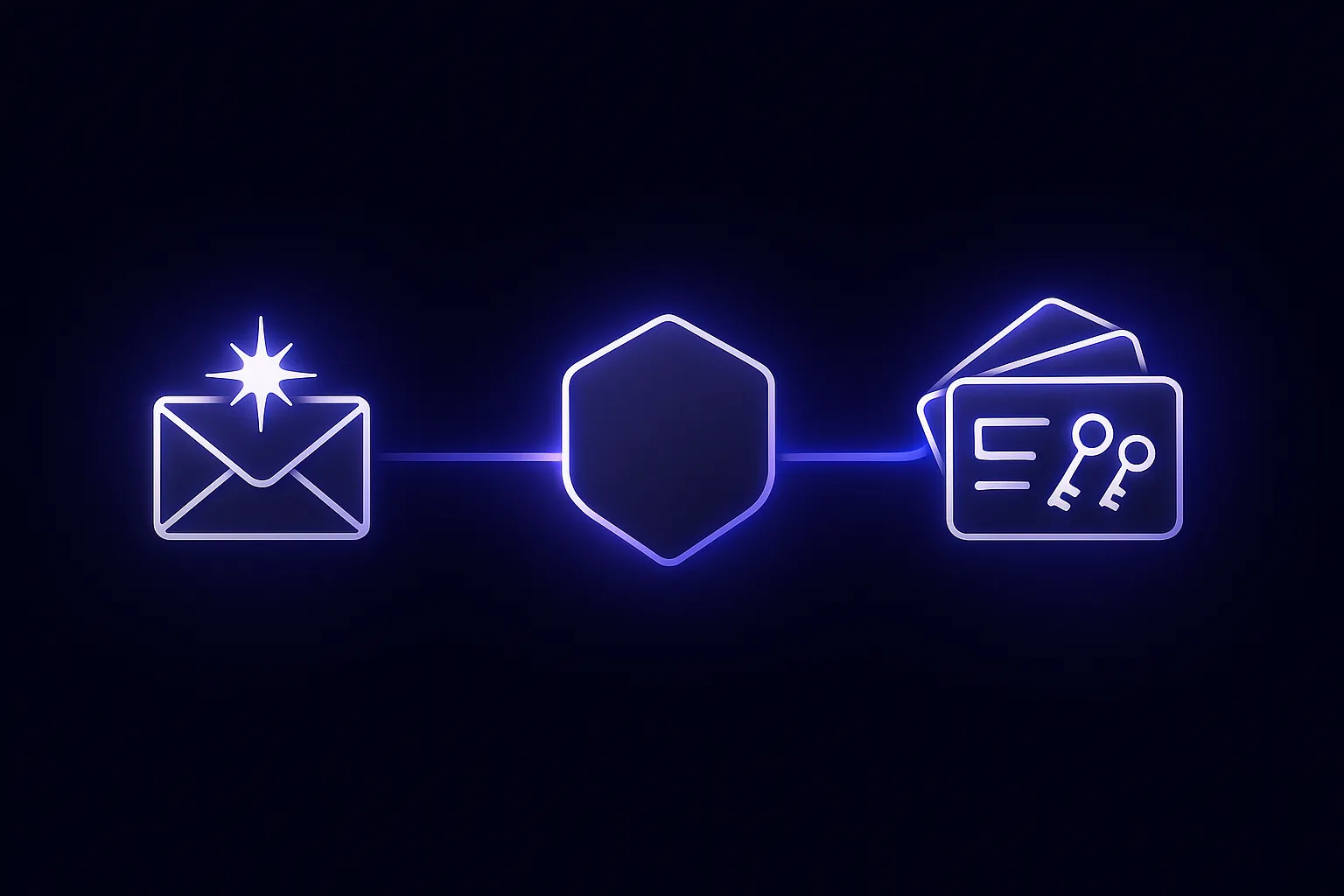
End users of the apps you build sign in the modern way: passwordless email — a one-time code or a magic link. No password to choose, forget, reuse, or leak.
That’s not a stylistic choice; it’s where authentication is going in 2026. Magic links and email OTP are the recommended low-friction entry point for new users, and the regulators agree on the direction — the FBI and CISA both issued formal guidance against SMS-only authentication in 2025. Email-based passwordless sits on the right side of that line, and it’s frictionless for the people using your product.
The result: the apps OwlMeans generates feel current out of the box, and you never write — or maintain — a credential-storage system again.
Your users are yours
This is the part we care about most, because it’s the part everyone else gets wrong.
The identities belong to you, the OwlMeans customer — not to a vendor, and not trapped inside our cloud. Users are managed customer-wide, shared across all the projects you build, while permissions are granted per project and, when you need it, per resource — scoped down to a specific thing inside the app (a department, a workspace, a record), or granted project-wide. Fine-grained access control, declared and enforced the way a senior engineer would do it, generated for you instead of hand-rolled.
And because identity is part of the code you own, it travels with you. An app you export and self-host outside our infrastructure can keep authenticating its users against OwlMeans identity — or, if you’d rather, connect your own enterprise identity provider instead. Either way, there’s no hostage situation. That’s the whole point of OwlMeans: code you actually own and can keep building with any agent — and that promise is worth very little if your users are locked in a box you can’t open.
Enterprise-ready from day one
If your customers are businesses, identity isn’t a feature — it’s a gate. Enterprise buyers expect SSO and OIDC before they’ll sign, and a missing checkbox on a security questionnaire can disqualify you before anyone looks at your actual product.
Because the OwlMeans identity layer is a built-in OIDC provider, every app you build is OIDC-native — it already speaks the protocol enterprises require. SSO isn’t a paid add-on you negotiate later; it’s the foundation the app is built on. The thing that usually blocks the deal is handled before the deal exists.
A quick look under the hood
We promised the business value first, so here’s the architecture in one breath, for the curious.
The platform now has a single identity abstraction that every generated app and every internal call codes against — never a specific backend directly. Behind that seam sits a built-in OIDC provider that issues RS256-signed tokens, a passwordless OTP/magic-link authentication path, and a scope-based permission model with two clean forms: resource-scoped grants and project-wide grants. Email delivery is pluggable. Identities live in the platform’s own datastore, partitioned per customer.
Two design decisions are worth calling out because they’re why the promises above hold:
- One contract, swappable engines. Because everything talks to the abstraction, the platform can run on its own integrated identity by default or point at your existing enterprise identity provider — without the generated app knowing or caring. The app always just speaks OIDC.
- Two identity worlds, never mixed. The platform’s own admin accounts and your apps’ end users are entirely separate stores. Your customers’ users are never entangled with ours.
That’s it. You get a modern, owned, enterprise-grade identity system; the pipeline carries the complexity.
Why this matters
OwlMeans has always argued that a coding agent is a coding agent — not a software development team. Identity is the cleanest example of the difference. Anyone can prompt their way to a sign-in screen. Almost no one prompts their way to passwordless auth, an OIDC provider, scoped permissions, owned user data, and a self-hostable escape route — correct, consistent, and generated as part of the build.
That’s the team-around-the-agent doing its job: turning capable generation into production-grade, ownable software — with the front door already built, and the keys already in your hand.
OwlMeans is an AI development pipeline: describe what you want as user stories and get full-stack apps, chatbots, AI agents, and data pipelines — typed, SSO-ready, and yours to keep building with any agent. See what it can do →